The whole vehicle
A tire finding, a cracked windscreen, a worn brake pad and a lighting fault land in the same cockpit. No second tool for everything except tires.
 Request a demo
Fleet Management
With the tire depth no generalist has. One cockpit for the whole vehicle, as an inspector sees it on the walkaround.
Demo data, fictional brands. Product UI shown in English.
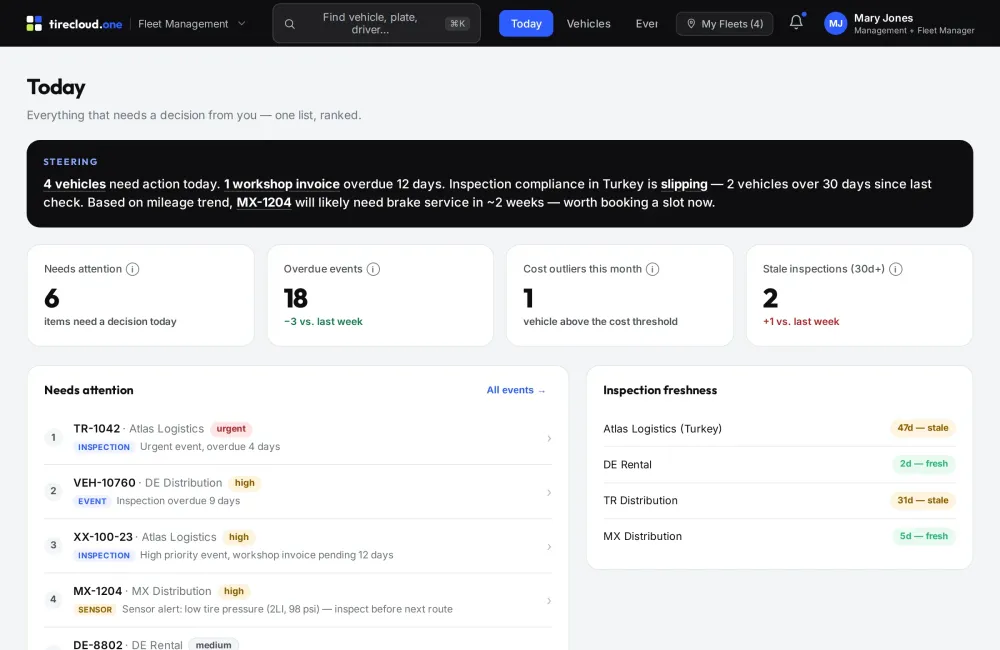 One-sentence summary of todayRanked by urgency
A tire finding, a cracked windscreen, a worn brake pad and a lighting fault land in the same cockpit. No second tool for everything except tires.
Each has its own condition and its own readiness to drive. Own trailers, trailers you are responsible for by contract, and third-party trailers are covered at the depth you need.
Legal minimum tread depth and inspection rules follow the country where the vehicle is, not only where it is registered.
Serial number, brand, measurements and fitting history from mounting to scrapping. When a tire is replaced, you record what happens to the old one.
Each closed event records how long the vehicle was out. Standard values become your workshop average over time.
When several findings appear, the system suggests what to bundle in one visit and what can be done at once, such as topping up air.
No. Telematics and sensor data, for example TPMS and GPS, are connected as an additional data source. Manual inspection is a full way to record findings and does not depend on them. 4 telematics systems are connected today, and we build no hardware of our own.
Telematics and sensors are data sources next to manual inspection, not a requirement. 4 telematics systems are connected. We build no hardware of our own.
For wholesalers: offer Fleet Management to your own fleet customers. You stay the contract partner, and the fleets are your customers.